HAVE YOUR SAY.
Join us in The Bullpen, where the members of the Scientific Inquirer community get to shape the site’s editorial decision making. We’ll be discussing people and companies to profile on the site. On Wednesday, January 25 at 5:30pm EST, join us on Discord and let’s build the best Scientific Inquirer possible.
Researchers from Tokyo Metropolitan University have found that biodiversity in large parks in urban environments can be affected by surrounding, smaller green areas. They surveyed two insect families in major parks in the Tokyo Metropolitan Area, one more mobile than the other. The more mobile family seemed to benefit from surrounding areas, while the less mobile species did not. Their work highlights the importance of managing smaller areas in maintaining biodiversity.
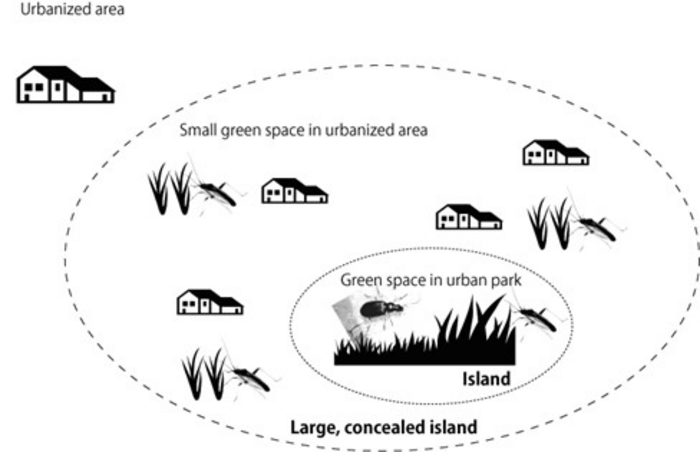
Prominent green spaces in urban centers provide habitats for local wildlife and are vital to maintaining biodiversity. However, that doesn’t mean other areas are devoid of life: for example, such spaces are often surrounded by smaller, fragmented patches of green like gardens and roadsides which form a “hospitable matrix” surrounding the central park or grassland. Though the composition and area of parks themselves are often the focus of studies, surrounding areas are often described as an impenetrable “sea” surrounding a central “island.” Its impact on biodiversity remains to be addressed.
A team led by Associate Professor Takeshi Osawa of Tokyo Metropolitan University surveyed wildlife inhabiting large parks in the Tokyo Metropolitan Area. They focused on two insect taxa, Carabidae, or the ground beetle, and Heteroptera. Heteroptera can fly over long distances and are thus more able to travel and spread to the matrix. Uniquely, the team characterized the quality of surrounding urban areas as habitats, using satellite data to gauge how smaller green spaces make the matrix either hospitable or inhospitable. Through detailed surveys looking at each of the taxa found in traps, they were able to quantify both their abundance and the number of discernible species.

For Heteroptera, they found that both the number of species and individuals caught was correlated with the area of the hospitable matrix. This is direct evidence for how biodiversity may be affected by a network of smaller green spaces surrounding the main “island.” On the other hand, they noticed that the diversity of Carabidae was unaffected. In fact, the number of Carabidae caught was actually negatively correlated with surrounding green spaces. They believe this to be due to predators using the hospitable matrix to access the central park area and present a threat to the beetles.
The team’s work highlights the important and often neglected role of small, fragmented green spaces in an urban environment which extends hospitable area for wildlife in parks and other prominent green spaces, effectively forming a larger “concealed island in the urban sea.” They hope that these findings inform effective conservation strategies to maintain and promote biodiversity in an increasingly urbanized environment.
IMAGE CREDIT: Tokyo Metropolitan University


Leave a Reply