HAVE YOUR SAY.
Join us in The Bullpen, where the members of the Scientific Inquirer community get to shape the site’s editorial decision making. We’ll be discussing people and companies to profile on the site. On Wednesday, November 23 at 5:30pm EST, join us on Discord and let’s build the best Scientific Inquirer possible.
There’s a popular saying that people who ignore history are doomed to repeat it. It turns out that there’s another reason not to ignore history according to new research from Michigan State University published in the journal Ecology.
When it comes to restoring ecosystems to their natural state, people can’t ignore history if they want to repeat successful efforts.
“Restoration is somewhat notorious for giving you different outcomes for very similar approaches,” said Chris Catano, a research associate in the Department of Plant Biology at MSU and first author of the new report. “There’s a lot of variability.”

Catano works with Lars Brudvig, a professor in the College of Natural Science. One of the Brudvig Lab’sprojects is illuminating the fundamental factors that contribute to that variability. With support from the National Science Foundation, this new study focuses on one of those factors — when a plot is restored — through the lens of biodiversity.
“What we’re seeing is that the past matters. History matters,” Catano said.
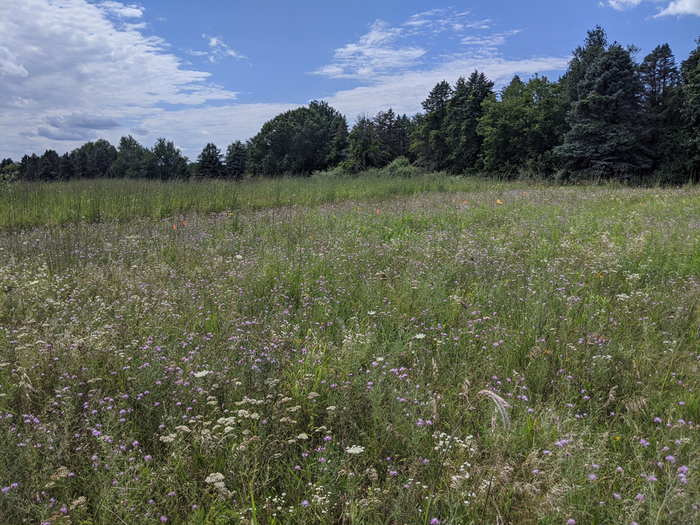
Working at a site that was once an active airstrip, the team restored 18 plots to prairie. The researchers kept all the restoration conditions as identical as possible except for when the restoration started.
They then tracked how different communities of organisms came together in those plots — for example, which species of plants grew and what other organisms they attracted. Beyond characterizing biodiversity, the team also analyzed how it affects the downstream ecological functions of a plot.
“This has been a huge question in ecology for nearly 30 years now, understanding what are the consequences of biodiversity for the ways an ecosystem functions,” said Brudvig, who is also a core faculty member of the Ecology, Evolution and Behavior Program, or EEB, at MSU.
Somewhat surprisingly, more biodiversity didn’t always translate to a more functional ecosystem in the team’s experiment.
There is a lot of evidence supporting a positive relationship between biodiversity and ecosystem function, but many of those studies were carried out in highly controlled environments, the team said. With its unique site, designed specifically to examine the effects of history, the team observed that the relationship is more complex in a more natural setting.
“We saw relationships that ranged from positive to neutral to negative,” Brudvig said. “In nature, the results are a huge mixed bag.”
Brudvig stressed that this work doesn’t discount the previous results or negate the conclusion that, generally speaking, more biodiversity is a good thing. In individual cases, however, Brudvig’s team is showing that the impact of biodiversity is nuanced and complicated — it can’t be summed up in a single value or measured quantity.
“There isn’t a number for biodiversity that tells you the whole story,” Catano said. “In this case, it was the identity of key species and their traits, which are hidden behind numbers, that really matter for how the ecosystems function.”
IMAGE CREDIT: Lars Brudvig




Leave a Reply