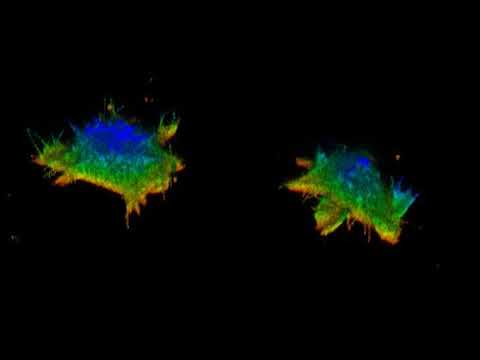
A team led by Johns Hopkins University engineers figured out how and why human cells move much faster through thick mucus than thinner varieties. People sick with certain diseases, including asthma and COVID-19, secrete mucus that is 2,000 times thicker than normal. Cells have fin-like “ruffles” that help them sense viscosity and know when to change shape to power through the thickest mucus, they found. The findings were published today in Nature Physics.
A pair of human kidney cells move through fluid. When the fluid changes from the viscosity of water to that of honey, the cells immediately flatten to become quicker and more efficient. SEE CORRESPONDING VIDEO/GIF: https://youtu.be/U7NAkjTaHFI
The findings could inform and inspire new treatment for mucus-related diseases, including chronic lung diseases and mucinous cancer—the deadliest subtype for lung and ovarian cancer.
HAVE YOUR SAY.
Join us in The Bullpen, where the members of the Scientific Inquirer community get to shape the site’s editorial decision making. We’ll be discussing people and companies to profile on the site. On Wednesday, August 3 at 5:30pm EST, join us on Discord and let’s build the best Scientific Inquirer possible.
Engineers discovered that certain cells don’t just passively experience the fluid that surrounds them, they use “ruffles” — cell membranes that wave up and down—to probe the fluid and adapt to its viscosity. Previously, ruffles were considered useless appendages. But the fin-like ruffles propel cells through thick mucus, helping them to swim faster in the thick stuff than more watery fluids. The research team included members from the University of Toronto and Vanderbilt University.
IMAGE CREDIT: Johns Hopkins University



Leave a Reply