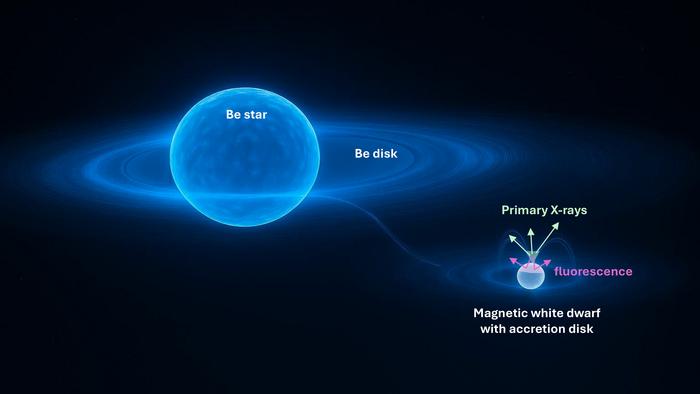
Visible to the naked eye in the constellation Cassiopeia, the star γ Cas has puzzled astrophysicists for half a century. It emits X-rays of an intensity and temperature incompatible with what one would expect from an ordinary massive star. Observations, carried out using the Resolve instrument aboard the Japanese XRISM telescope, now allow us to attribute this emission to the white dwarf orbiting γ Cas. This also confirms the existence of a family of binary systems long predicted to exist but never identified. The results of this study, led by astronomers from the University of Liège, have been published in the journal Astronomy & Astrophysics
γ Cassiopeia was the first Be-type star to be identified as such by the Italian astronomer Angelo Secchi in 1866. Be stars are fast-rotating massive stars that regularly eject matter. This matter forms a disc around the star, the presence of which is revealed by characteristic emissions in their optical spectrum. In 1976, it became apparent that γ Cas emitted X-rays with a luminosity approximately forty times greater than that of comparable massive stars, with plasma heated to over 100 million degrees and unusually rapid variability. Two decades of monitoring by major space observatories subsequently revealed around twenty objects sharing these same properties, forming a subclass of stars dubbed ‘γ Cas analogues’. Astronomers at University of Liège have, in fact, played a crucial role, having identified more than half of these objects.
“Several scenarios had been proposed to explain this emission,” explains Yaël Nazé, an astronomer at ULiège. “One of them involved local magnetic reconnection between the surface of the Be star and its disc. Others suggested X-rays to be linked to a companion, whether a star stripped of its outer layers, a neutron star, or an accreting white dwarf*.” Astronomers at ULiège had already ruled out the first two types of companions based on contradictions between observations and theoretical predictions. The accreting white dwarf and magnetic interactions remained possible candidates, but no observation allowed to choose between them.

To settle the matter, the team conducted a campaign using Resolve, the microcalorimeter on board the Japanese XRISM space telescope, an instrument that provides spectra with unrivalled precision and is revolutionising high-energy astrophysics. Three observations were carried out: in December 2024, February and June 2025. These observations covered the full range of the binary system’s orbital motion, which has a period of 203 days.
“The spectra revealed that the signatures of the high-temperature plasma change velocity between the three observations, following the orbital motion of the white dwarf rather than that of the Be star,” the researcher continues. “This shift was measured with high statistical reliability. It is, in fact, the first direct evidence the the ultra-hot plasma responsible for the X-rays is associated with the compact companion, and not with the Be star itself.”
The moderate width of these signatures (of the order of 200 km/s) provides additional information. It effectively rules out the case of a non-magnetic white dwarf, where accretion occurs in the inner regions of the disc, which are rotating rapidly and thus produce very broad signatures. The observations therefore suggest instead that the white dwarf is magnetic: the disc is then truncated and the magnetic field channels the accreting material towards its poles (see figure).
These results allow γ Cas and its analogues to be identified as Be + white dwarf binaries, a population of objects long predicted but never clearly identified. Astronomers at ULiège have also highlighted two distinctive features of this population: it mainly concerns massive Be stars, accounting for around 10% of them. Theoretical models, however, predicted a proportion not only higher but also linked to low-mass Be stars. “This discrepancy suggests a revision of binary evolution models, particularly regarding the efficiency of mass transfer between components—a conclusion that aligns with that of several recent independent studies. Solving this mystery therefore opens up new avenues of research for the years to come! Understanding the evolution of binary systems is crucial for comprehending, for example, gravitational waves, as it is indeed massive binaries that emit them at the end of their lives,” concluded Yaël Nazé.
IMAGE CREDIT: University of Liège / Y.Nazé.



Leave a Reply