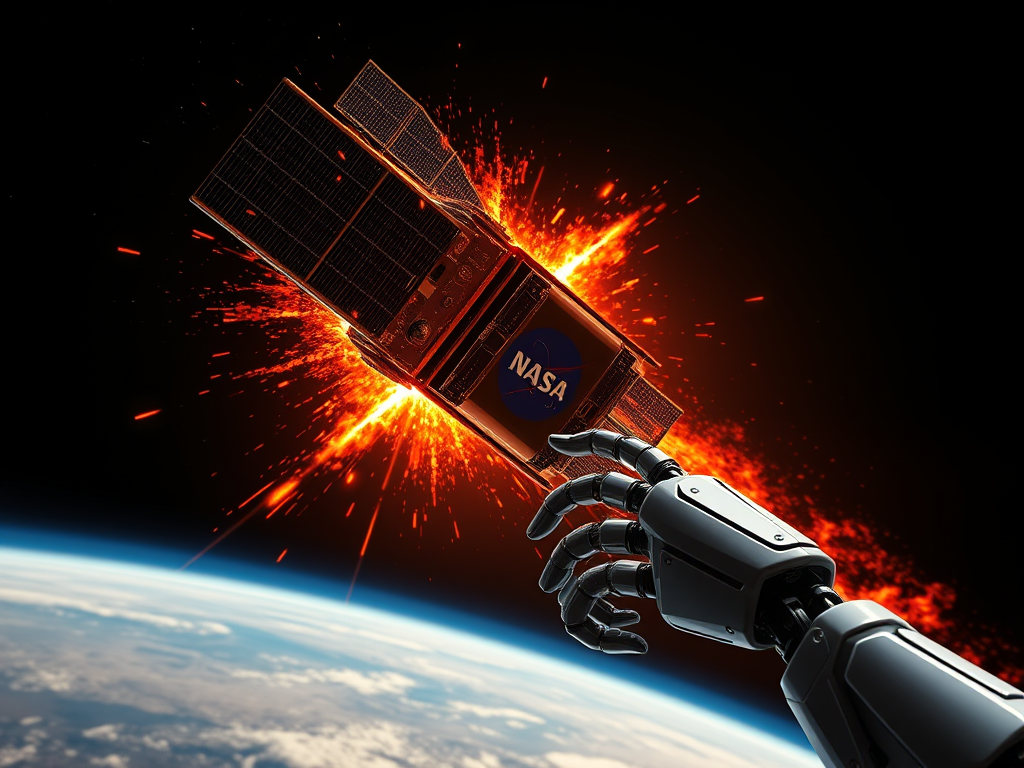
NASA Satellite’s Risky Return From the Van Allen Belts
A NASA spacecraft that spent more than a decade studying Earth’s Van Allen radiation belts is now expected to make an uncontrolled reentry into the atmosphere, with a small fraction of its 1,323-pound mass likely surviving to the ground. The satellite, Van Allen Probe A, launched in 2012 and was part of a mission that revealed major discoveries, including evidence for a temporary third radiation belt. Although the chance of anyone being harmed is low—about 1 in 4,200—that risk is higher than the US government’s usual reentry safety standard. NASA said late design changes increased the hazard, but the agency granted a waiver because of the mission’s scientific value. Faster-than-expected orbital decay, driven by heightened solar activity, brought the satellite down years earlier than originally forecast. (Ars Technica)
MIT Trains AI to Turn Images Into Reliable Robot Plans
MIT researchers unveiled a two-stage system called VLM-guided formal planning that tries to fix one of robotics’ persistent weak spots: turning messy visual scenes into long, dependable action plans. The approach first uses a specialized vision-language model to describe what is happening in an image and simulate possible actions, then hands that information to a second model that translates the problem into a formal planning language classical solvers can actually execute. MIT says the system generated plans with about a 70% average success rate versus roughly 30% for leading baselines, and it showed strong generalization to new tasks, including multirobot collaboration and robotic assembly scenarios. That makes it notable not just as another generative-AI demo, but as a practical bridge between perception-heavy AI and old-school reliable planning. (MIT News)
Robotic Microfluidics Pushes mRNA Delivery Design Into High Gear
At the University of Pennsylvania, engineers introduced LIBRIS, an automated robotic microfluidic platform built to accelerate the search for better lipid nanoparticles, the delivery vehicles used in mRNA medicines. The core advance is speed and scale: the system can generate around 1,000 distinct formulations per hour, producing the kind of large, systematic datasets that predictive AI models need but manual experimentation has struggled to supply. Researchers say the platform could accelerate lipid nanoparticle development by as much as 100-fold, potentially speeding the design of more efficient and targeted therapeutics. This is robotics not as spectacle but as laboratory infrastructure: a machine that expands the pace of experimental biology. In a week full of humanoid headlines, LIBRIS stands out because it targets a real bottleneck in translational medicine and vaccine-era drug delivery. (Phys.org)
UT Austin’s Robot Hand Can Lift a Potato Chip Without Breaking It
Researchers at the University of Texas at Austin reported a new robotic hand system called FORTE—Fragile Object Grasping with Tactile Sensing—designed to handle delicate items that many robots still fumble. The team says the hand can pick up objects as fragile as a potato chip or raspberry without crushing them, thanks to a combination of tactile sensing and soft-robotics design. That may sound modest, but it addresses one of the hardest gaps in robotics: fine manipulation. Robots have improved at big motions and repetitive tasks, yet still struggle with the subtle force control needed for unpacking fruit, handling eyeglasses, or performing sensitive medical and manufacturing work. UT frames FORTE as a step toward giving machines a more genuinely useful sense of touch, which remains one of the field’s most important frontiers. (UT Austin News)
Oxford Cuts Soft-Robot Fabrication to Minutes and Pennies
Oxford engineers described a strikingly simple manufacturing method that could make soft robotics far cheaper and more accessible. Instead of relying on specialized silicone molding or expensive fabrication systems, the team uses commercial vacuum-sealable thermoplastic pouches, a standard vacuum sealer, and laser cutting to create inflatable soft actuators in a single cut-and-seal step. According to Oxford, each actuator can be made in under 10 minutes for less than 10 cents, while still delivering useful performance: the resulting soft gripper lifted 25 times its own weight, and the actuators survived up to 100,000 inflation-deflation cycles in durability tests. That combination of low cost, speed, and repeatability matters because soft robotics has often been slowed by laborious prototyping. This work could widen access for labs, startups, and classrooms alike. (eng.ox.ac.uk)
Northwestern’s ‘Metamachines’ Aim for Robots That Survive Damage
Northwestern researchers introduced what they describe as the first modular robots with athletic intelligence: “legged metamachines” built from autonomous Lego-like modules, each with its own motor, battery, and onboard computation. What makes the work pop is not just modularity, but resilience. The machines can be recombined into multiple body plans, right themselves after being flipped, adapt to losing a limb, and continue moving across rugged outdoor terrain including grass, gravel, roots, sand, and mud. The designs were generated through AI-driven evolutionary search rather than copied from familiar dog- or human-like robot forms, producing unusual but highly functional configurations. Published in PNAS on March 6, the work points toward robots that are less brittle, less fixed, and more biologically suggestive: machines that can be repaired, reshaped, and redeployed instead of discarded when something breaks. (Northwestern Now)
Cat Paws and Elephant Trunks Inspire Faster Tactile Robot Design
A King’s College London team reported a new simulation-driven framework meant to speed up one of tactile robotics’ most expensive phases: designing and training sensor-rich robot hands and other touch-sensitive devices. Their platform, SimTac, uses biologically inspired models based on natural sensing structures such as cat paws, octopus tentacles, and elephant trunks to explore different tactile sensor shapes in virtual environments before building them physically. King’s says that could cut the design-and-training cycle for tactile robots from as long as 18 months to roughly two weeks. The group also ties the work to GenForce, an AI system modeled on human tactile memory, with the goal of training complex robotic hands using far fewer high-end force sensors. If that promise holds, it could reduce both development time and cost in applications ranging from factory pickers to prosthetics. (King’s College London)
Science Advances Paper Claims a Step Toward Human-Level Robotic Dexterity
One of the more academically significant robotics items this week came via Science Advances, which published a paper titled Touching with torque enables human-level robotic dexterity. The article’s framing is ambitious, but the underlying point is clear: forceful, adaptive manipulation remains one of the hardest unsolved problems in robotics, and the authors argue that robots need richer interaction sensing—especially torque-related feedback—to close the gap with human hands. The paper positions environmental interaction, including pressure, torsion angle, and torque, as central to achieving more robust manipulation across industry, health care, and service contexts. Because the accessible search results are limited mostly to abstract-level material, this is one of the thinner summaries in today’s batch. Even so, it stood out as one of the week’s most notable directly journal-linked robotics papers. (Science)
BMW Puts Humanoid Robot AEON to Work in Leipzig
BMW’s latest robotics move is less about hype videos and more about integration strategy. The company said its Leipzig plant is piloting the humanoid robot AEON, developed with Hexagon, marking BMW’s first use of humanoid robots in production in Germany. AEON is being tested in high-voltage battery assembly and component manufacturing, where repetitive lifting, logistics, and ergonomically awkward tasks could be shifted away from workers. BMW describes the broader initiative as part of its “physical AI” push, combining AI agents, shared plant data models, and adaptable robotic hardware. The company says AEON made its operational debut in Leipzig in December 2025, with further testing scheduled this spring ahead of deeper pilot operations in summer 2026. For now, the story is not mass deployment but careful testing of where humanoids can provide real manufacturing value. (BMW Group)
NASA’s Dragonfly Reaches a Major Rotorcraft Milestone
NASA announced that Dragonfly, its rotorcraft mission to Saturn’s moon Titan, has entered the integration and testing stage at Johns Hopkins Applied Physics Laboratory. That matters because Dragonfly is not just another planetary probe; it is effectively a flying robot built to hop across Titan’s surface, sampling multiple locations in one mission. According to NASA, subsystem integration will continue through this year, with system-level testing planned in early 2027, followed by final space-environment testing and a planned 2028 launch on a Falcon Heavy. This week’s update is a milestone story rather than a science-results story, but it still belongs in a robotics-heavy roundup because Dragonfly is one of the most ambitious autonomous exploration machines in development. Its progress signals that advanced robotic mobility remains central to the next era of planetary science. (NASA Science)
Diatom Microrobots Take Aim at Glioblastoma
Researchers in China reported a striking biomedical robotics concept: magnetically controlled microrobots made from diatoms, the silica-shelled microscopic organisms found in aquatic environments. According to the release, the team preserved the diatoms’ natural chlorophyll so the structures could act as photosensitizers for photodynamic therapy, while external magnetic fields guided them toward glioblastoma lesions. The robots reportedly navigated along preset paths using AI-assisted closed-loop control and, in mouse experiments, reduced the survival rate of primary glioblastoma cells to 19.5% without significant systemic toxicity. This is still early-stage work, not a clinical treatment, and the delivery method described involved direct injection into brain lesions in animal models. Still, as a fusion of microrobotics, natural biomaterials, and cancer therapy, it was one of the week’s most unusual and technically intriguing robotics stories. (EurekAlert!)



Leave a Reply