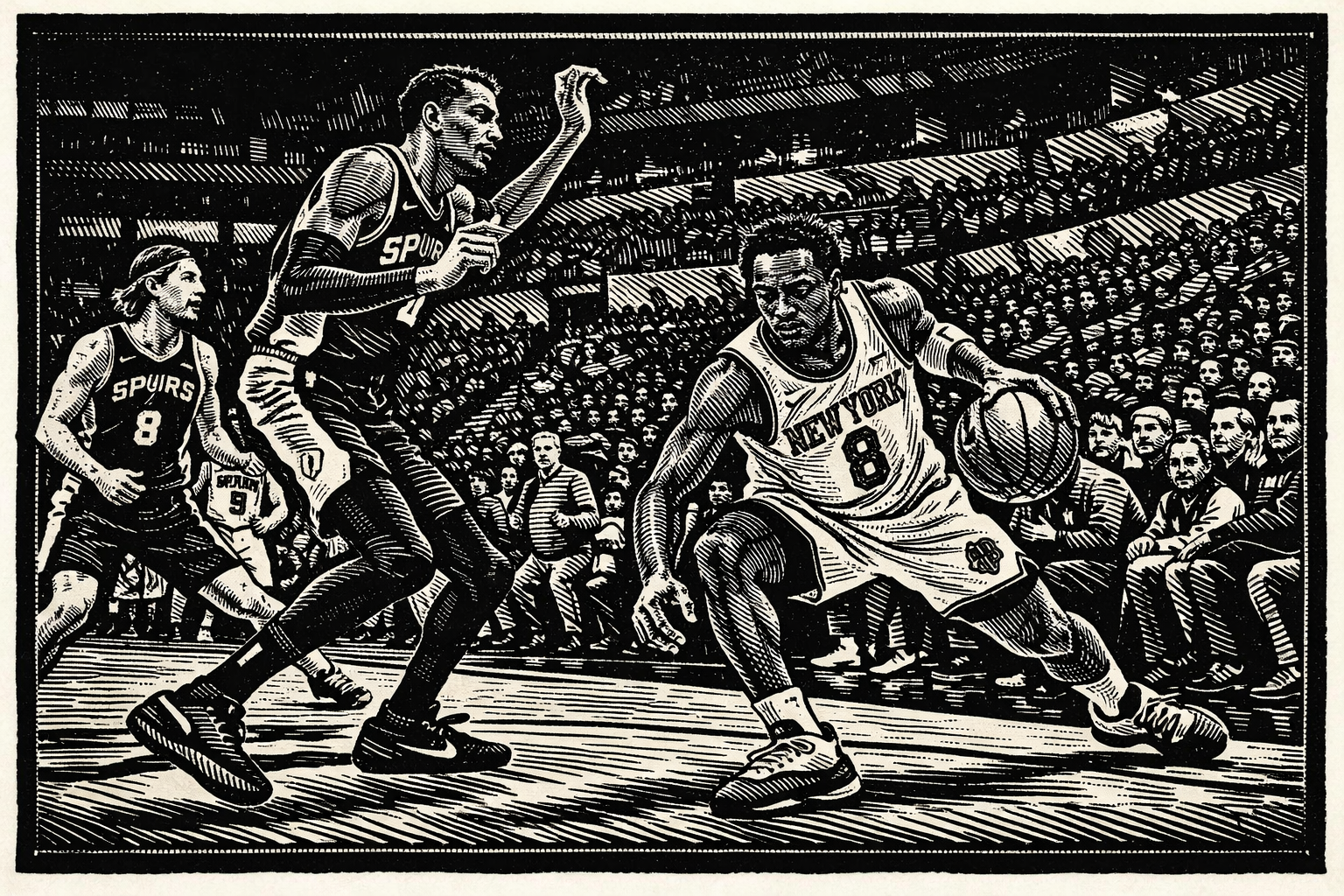
That banging you may have heard Sunday night, echoing in the chilly winter night, was the sound of Knicks fans watching their team blow out Victor Wembanyama’s San Antonio Spurs and wishing they played them every night. If only they played like this against Detroit…
The New York Knicks didn’t just beat the San Antonio Spurs — they buried them under an avalanche of extra possessions. The final score, 114–89, reflects control. The underlying math explains domination.
The headline number: a 97–77 edge in field-goal attempts for New York — a staggering +20 shot-attempt margin. In modern NBA terms, that’s a possession landslide. Given league-average efficiency (roughly 1.10–1.15 points per possession), 20 extra attempts alone project to a 22–23 point swing before even accounting for shot quality. The Knicks won by 25. That correlation isn’t coincidence; it’s arithmetic.
Lever No. 1: Offensive Rebounding
The first engine behind the margin was the glass. New York finished with a 54–41 rebounding advantage, repeatedly extending possessions and denying San Antonio the ability to reset defensively. Offensive rebounds are multiplicative events — they don’t just create extra shots, they often generate higher-efficiency second-chance looks at the rim or from kick-out threes against a scrambling defense.
Even a modest edge of +5 to +7 offensive boards typically translates into 6–10 additional field-goal attempts. In this game, the rebounding dominance laid the foundation for volume control. When one team is consistently shooting the “last shot” of a possession cycle, the math compounds quickly.
Lever No. 2: Forced Turnovers
The second driver: defensive disruption. The Knicks forced the Spurs into rushed decisions during a decisive 34–6 run, flipping what had been a competitive early stretch into a runaway. Turnovers are the cleanest path to shot-attempt margin because they eliminate an opponent’s scoring opportunity entirely while often producing transition chances the other way.
Every live-ball turnover effectively functions as a two-possession swing — one shot denied, one shot created. Even a +5 turnover differential can swing shot attempts by 7–10 when factoring in transition pace. Combine that with offensive rebounding, and you’re approaching the +20 territory that defined this contest.
Lever No. 3: Pace Control
While pace alone doesn’t guarantee a shot-attempt gap, tempo manipulation amplifies structural advantages. During their decisive stretch, the Knicks accelerated selectively — pushing after defensive stops but remaining patient in half-court sets. That balance matters. Fast after turnovers, deliberate after rebounds. The result is more total possessions — but disproportionately tilted toward one side.
In analytical terms, this is the “possession squeeze”: win the glass, force mistakes, convert quickly, then force the opponent into lower-efficiency half-court attempts late in the clock. That cycle doesn’t just inflate attempts; it suppresses opponent efficiency.
Why +20 Is a Blowout Threshold
Historically, teams that post a +15 or greater shot-attempt margin win at an overwhelming rate. Crossing +20 almost guarantees a double-digit victory unless shooting variance swings wildly the other direction. Even if both teams shoot the same percentage, the math overwhelmingly favors the volume winner.
In Knicks–Spurs, shooting efficiency was secondary. Volume was destiny. New York didn’t need unsustainable three-point variance or an outlier scoring night from a superstar. They weaponized possession economics.
The lesson is clear: while highlight reels celebrate shot-making, the “Shot-Attempt Margin Monster” lives underneath — in rebounding angles, deflections, and transition reads. When a team controls attempts by 20, the scoreboard is often just a formality.




Leave a Reply