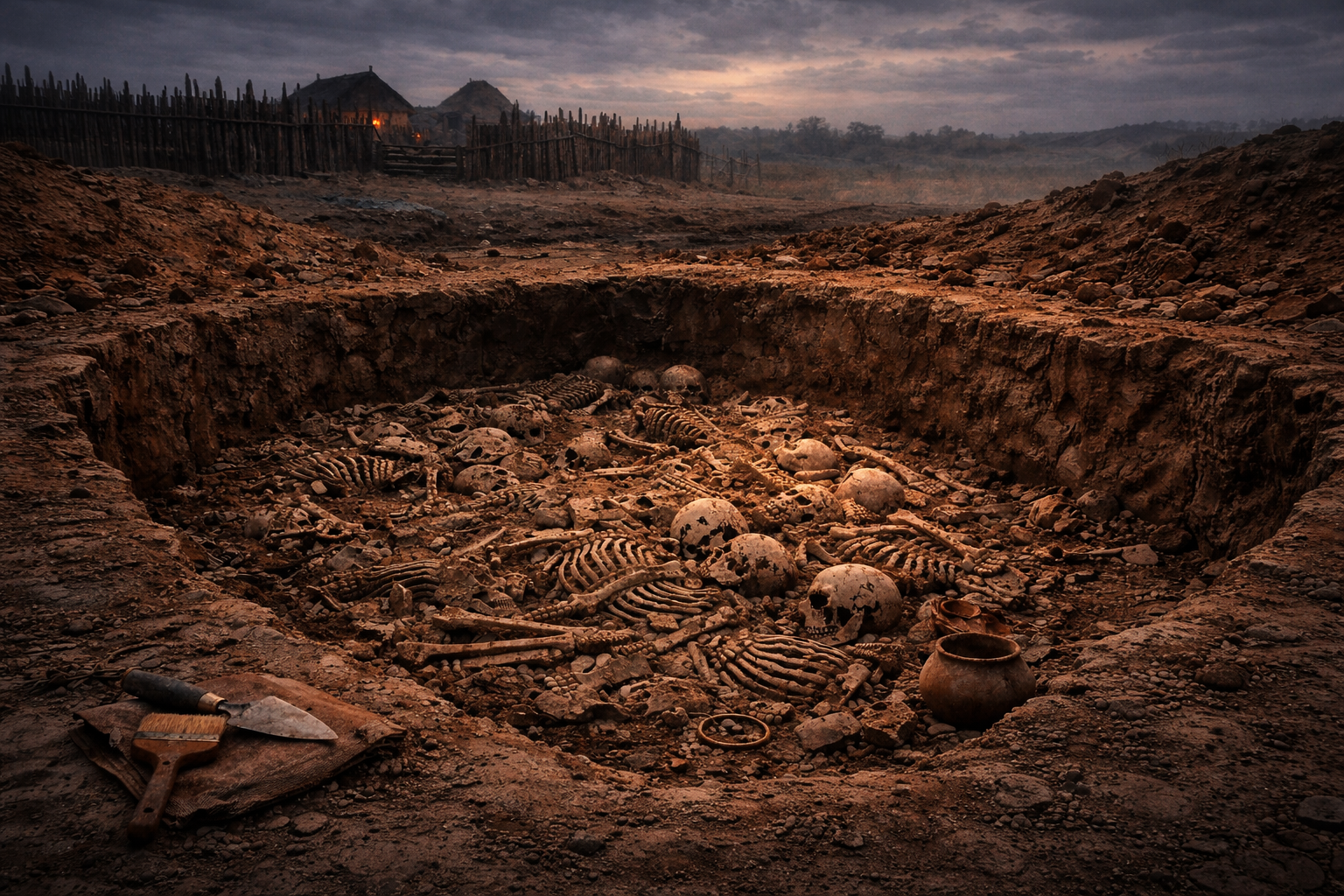
When archaeologists first excavated the Gomolava tell site in northern Serbia in the 1970s, they concluded that the mass grave they uncovered — containing more than 77 individuals stacked in layers — was likely the result of a pandemic. Decades later, a sweeping reanalysis of those same remains has shattered that interpretation entirely, revealing instead one of the most chilling episodes of targeted mass violence ever documented in prehistoric Europe.
Published in Nature Human Behaviour, the new study brings together ancient DNA analysis, isotope geochemistry, bioarchaeology, and metallurgical examination to reconstruct what happened at Gomolava around 800 BCE. What the researchers found was not a community wiped out by disease, but a population deliberately selected, gathered, and killed — predominantly women and children from across a broad region of what is now the Carpathian Basin.

“When we encounter mass graves from prehistory with this kind of demographic, we might expect they were families from a village that was attacked,” said co-lead researcher Associate Professor Barry Molloy of University College Dublin’s School of Archaeology. “Gomolava genuinely took us by surprise when our genetic analysis showed the majority of people studied were not only unrelated — not even their great-great-grandparents were. This was highly unusual for a prehistoric mass grave and not what we expect to find if they had all lived together in a village.”
Of the 77 individuals analyzed bioarchaeologically, 40 were juveniles between the ages of one and twelve, 11 were adolescents, and 24 were adults. Of those whose biological sex could be determined, 70.8% were female. Among adults specifically, the proportion climbed to 87%. Only a single infant was found, and it was male. The near-total absence of adult men is one of the study’s most striking findings, and researchers suggest the missing males were either the perpetrators, killed elsewhere, or taken for other purposes.

The evidence for violence is extensive and unambiguous. At least 20% of individuals showed skeletal trauma consistent with violent injury, with peri-mortem — meaning unhealed, occurring at or near the time of death — wounds found concentrated on the skull. The injuries, mostly blunt force trauma, appear to have come from above or behind, suggesting victims who were fleeing, on the ground, or facing attackers who were taller or possibly on horseback. One individual showed a defensive wound. Others bore injuries consistent with arrows or spears.
“The brutal killings and subsequent commemoration of the event can both be read as a powerful bid to balance power relations and assert dominance over land and resources,” said co-lead Dr. Linda Fibiger of the University of Edinburgh.
What sets Gomolava apart from other prehistoric mass graves is not just who was killed, but how they were buried. Unlike the hastily filled pits typical of massacre sites, this grave shows evidence of deliberate ritual. Bronze personal ornaments, ceramic drinking vessels, and animal remains — including most of a young cow placed beneath the human remains — were interred alongside the victims. Quern stones were broken and placed on top, and concentrations of burnt seeds marked the grave’s center. The closest parallel in European prehistory is the fifth- to fourth-century BCE massacre at Fin Cop hillfort in England, where victims recovered from a ditch were exclusively women and children.

The genetic data deepens the mystery and the horror. Using low-coverage genome sequencing of 25 individuals, the researchers found almost no close biological relationships among the victims. Only three individuals — a mother and her two daughters — shared first-degree kinship. An identity-by-descent analysis confirmed that most of the buried individuals did not even qualify as sixth-degree relatives. This finding rules out the possibility that Gomolava represents the destruction of a single family unit or small settlement, a pattern seen at sites like the approximately 5,000-year-old mass grave at Koszyce in southern Poland, where the dead were largely close and extended relatives.
Strontium isotope analysis of tooth enamel added another dimension to the picture. The data showed disparate childhood origins among the victims, with 35% of sampled individuals having grown up tens of kilometers or more away from Gomolava. Carbon and nitrogen stable isotope results revealed a wide variety of diets, suggesting the group drew from multiple communities with different subsistence strategies. Population modeling based on identity-by-descent patterns estimated that the meta-population from which the victims were drawn numbered somewhere between 10,000 and 14,000 individuals — a sizeable network spread across the South Pannonian Plain.

The researchers situate the killings within a specific and turbulent historical moment. Gomolava lies at the intersection of the late Urnfield cultural tradition to the north and west and the Kalakača pottery tradition to the south, while steppe-associated Thraco-Cimmerian metalwork styles were also arriving in the region from the east. Archaeological evidence from the mid-ninth century BCE suggests communities were reoccupying Bronze Age tells and establishing new enclosed settlements — acts that would have made explosive territorial claims on a contested landscape.
“Our team has been tracing the Bronze Age collapse and its aftermath in Europe,” Molloy said. “What we found at Gomolava tells us that as things recovered in this area moving into the Iron Age, reasserting control over landscapes could include widespread and extremely violent episodes between competing groups.”
The study’s implications extend beyond the specifics of one site. For scholars of prehistoric violence, Gomolava provides the clearest evidence yet that mass killings in later European prehistory could be demographically selective — not simply a decimation of combatants or an indiscriminate massacre, but a targeted act aimed at severing regional social networks by eliminating women and children who served as linchpins of kinship, labor, and community continuity. The authors suggest the act may even have carried symbolic resonance, echoing the prehistoric practice of deliberately depositing hoards of valuable objects near rivers.
The site reminds us that organized, strategic, gender-directed violence is not a modern invention. It has roots that reach back nearly three millennia — and the tools to document it are only now mature enough to reveal its full scope.
Endnotes
- Fibiger, L., Iraeta-Orbegozo, M., et al. “A large mass grave from the Early Iron Age indicates selective violence towards women and children in the Carpathian Basin.” Nature Human Behaviour (2026). DOI: 10.1038/s41562-025-02399-9
- EurekAlert! press release: “Iron Age massacre targeted women and children, new research reveals.” UCD Research & Innovation, February 23, 2026.
- Schroeder, H. et al. “Unraveling ancestry, kinship, and violence in a Late Neolithic mass grave.” Proceedings of the National Academy of Sciences 116 (2019): 10705–10710.
- Waddington, C. et al. “Excavations at Fin Cop, Derbyshire: an Iron Age Hillfort in conflict?” Archaeological Journal 169 (2012): 159–236.
- Molloy, B. et al. “Resilience, innovation and collapse of settlement networks in later Bronze Age Europe: new survey data from the southern Carpathian Basin.” PLoS ONE 18 (2023): e0288750.
- Novak, M. et al. “Genome-wide analysis of nearly all the victims of a 6200 year old massacre.” PLoS ONE 16 (2021): e0247332.
- Fontijn, D. Economies of Destruction: How the Systematic Destruction of Valuables Created Value in Bronze Age Europe, c. 2300–500 BC. Routledge, 2019.




Leave a Reply