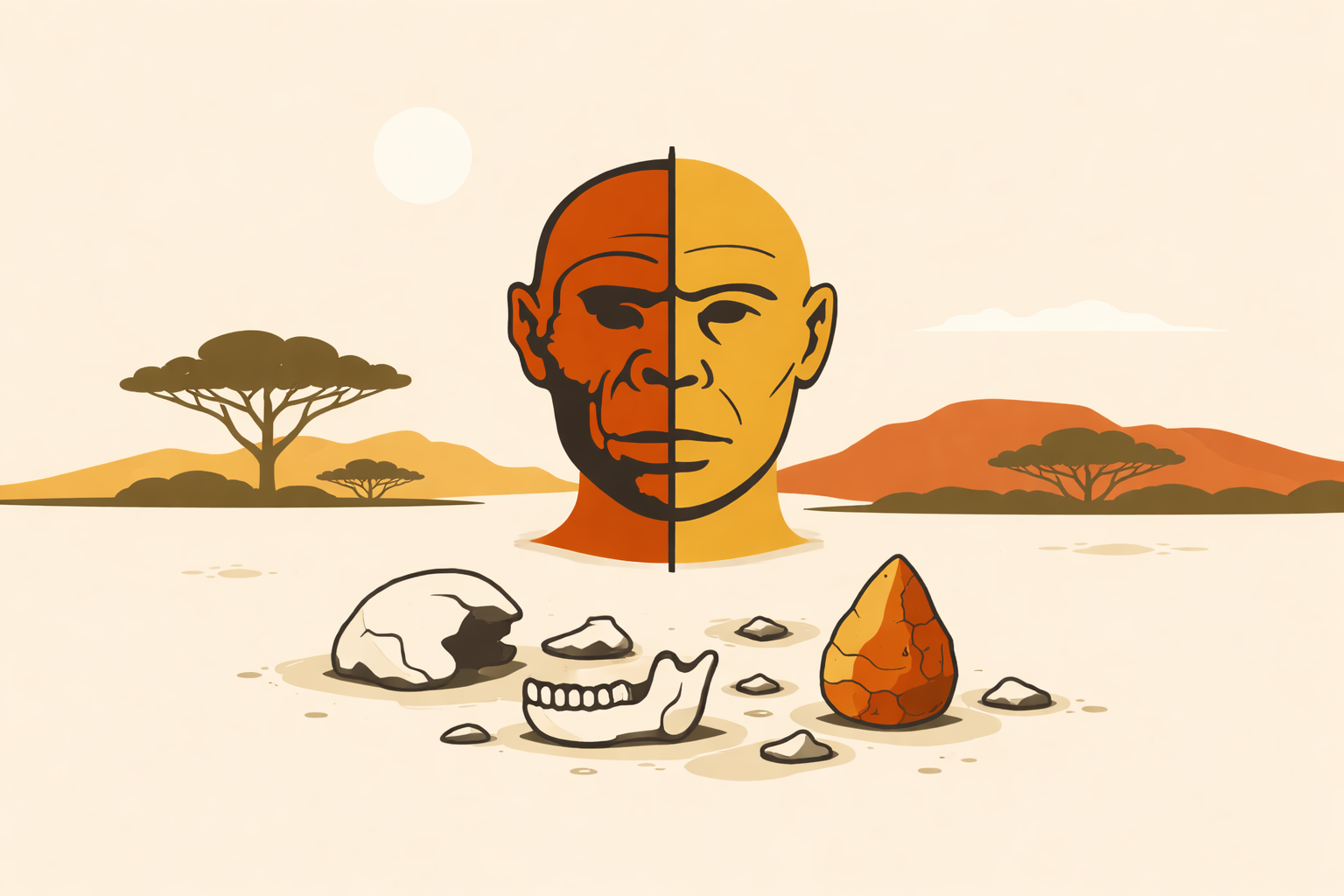
A 1.5-million-year-old skull from Ethiopia is challenging scientists’ understanding of how our ancient ancestors evolved and spread across the globe.
An international research team has virtually reconstructed the face of an early human ancestor known as DAN5, using fragments discovered at Gona in Ethiopia’s Afar region. The result is the most complete Early Pleistocene Homo cranium from the Horn of Africa—and it presents a surprising puzzle for paleoanthropologists.

The fossil belongs to Homo erectus, the first human species to venture beyond Africa and colonize much of the Old World between two million and one million years ago. Yet despite living alongside more anatomically advanced members of its species, this individual retained remarkably primitive facial features, suggesting the emergence of Homo erectus was far more complicated than researchers previously believed.
“We already knew that the DAN5 fossil had a small brain, but this new reconstruction shows that the face is also more primitive than classic African Homo erectus of the same antiquity,” said Dr. Karen Baab, a paleoanthropologist at Midwestern University who led the reconstruction effort. “One explanation is that the Gona population retained the anatomy of the population that originally migrated out of Africa approximately 300,000 years earlier.”

The findings, published in Nature Communications, emerge from years of painstaking work assembling digital models of fragmented bone. The original face pieces were recovered during fieldwork at Gona in 2000, while the braincase was first described in 2020. Using high-resolution micro-CT scans, the researchers created three-dimensional models of the fragments and pieced them together like a complex jigsaw puzzle.
“This was a very complicated 3D puzzle, and one where you do not know the exact outcome in advance,” Baab explained. “Fortunately, we do know how faces fit together in general, so we were not starting from scratch.”

What makes this fossil particularly significant is the timing. At 1.6 to 1.5 million years old, DAN5 lived during a period when Homo erectus populations in other parts of East Africa had already developed more advanced cranial features. The contrast between contemporaneous populations suggests complex population dynamics rather than simple linear evolution.
Homo erectus represents a pivotal chapter in human evolution. According to the Smithsonian Institution’s Human Origins Program, this species descended from an earlier ancestor like Homo habilis and achieved one of the widest dispersals of early humans in evolutionary history. The species likely gave rise to later hominins and ultimately contributed to the lineage that produced modern humans.

The Dmanisi fossils from Georgia, dated to approximately 1.8 million years ago, had previously revealed similar mosaics of primitive and derived traits outside Africa. UNESCO describes the Dmanisi specimens as “the most primitive and small-brained humans found outside of Africa” attributed to Homo erectus. The DAN5 fossil now demonstrates that such transitional forms also existed within Africa itself.
“I’ll never forget the shock I felt when Dr. Baab first showed me the reconstructed face and jaw,” said Dr. Yousuke Kaifu of the University of Tokyo, a study co-author.
The implications extend to one of paleoanthropology’s most debated questions: where exactly did Homo erectus originate? The discovery of transitional fossils like DAN5 within Africa strengthens the case for African origins.
“The oldest fossils belonging to Homo erectus are from Africa, and the new fossil reconstruction shows that transitional fossils also existed there, so it makes sense that this species emerged on the African continent,” Baab noted.

The archaeological context adds another layer of intrigue. The DAN5 site has yielded both simple Oldowan stone tools and more sophisticated Acheulean handaxes—some of the earliest evidence for both traditions found directly associated with hominin remains.
“It is remarkable that the DAN5 Homo erectus was making both simple Oldowan stone tools and early Acheulian handaxes, among the earliest evidence for the two stone tool traditions to be found directly associated with a hominin fossil,” said Dr. Sileshi Semaw of Spain’s Centro Nacional de Investigación sobre la Evolución Humana.
This combination of behavioral sophistication with primitive anatomy challenges assumptions that technological innovation necessarily accompanied morphological advancement.
“This newly reconstructed cranium further emphasizes the anatomical diversity seen in early members of our genus, which is only likely to increase with future discoveries,” said Dr. Michael Rogers of Southern Connecticut State University.
The research team plans to compare DAN5 with the earliest human fossils from Europe. Future research may also explore whether interbreeding between different hominin species could explain the mosaic of features observed.
“We’re going to need several more fossils dated between one to two million years ago to sort this out,” Rogers acknowledged.
For now, the reconstructed face from Gona stands as testament to both the complexity of human evolution and the power of modern imaging technology to resurrect ancient anatomy from fragmentary remains.
Endnotes:
- Baab, K.L., Kaifu, Y., Freidline, S.E., Rogers, M.J. & Semaw, S. (2025). New reconstruction of DAN5 cranium (Gona, Ethiopia) supports complex emergence of Homo erectus. Nature Communications, 16:10878. https://doi.org/10.1038/s41467-025-66381-9
- Midwestern University Press Release. (2025, December 16). A new fossil face sheds light on early migrations of ancient human ancestor. EurekAlert! https://www.eurekalert.org/news-releases/1109588
- Smithsonian Institution Human Origins Program. Homo erectus. https://humanorigins.si.edu/evidence/human-fossils/species/homo-erectus
- UNESCO World Heritage Centre. Dmanisi Hominid Archaeological Site. https://whc.unesco.org/en/tentativelists/5225/





Leave a Reply