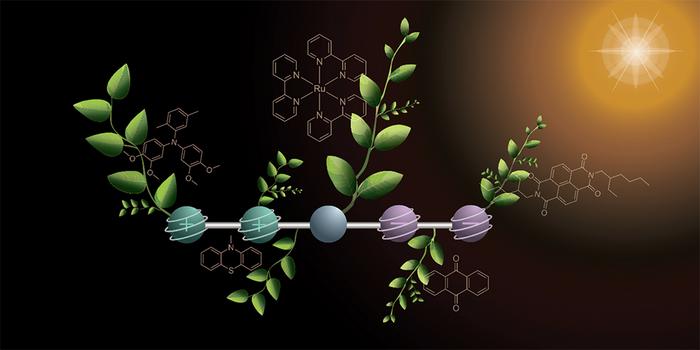
A research team from the University of Basel, Switzerland, has developed a new molecule modeled on plant photosynthesis: under the influence of light, it stores two positive and two negative charges at the same time. The aim is to convert sunlight into carbon-neutral fuels.
Plants use the energy of sunlight to convert CO2 into energy-rich sugar molecules. This process is called photosynthesis and is the foundation of virtually all life: animals and humans can “burn” the carbohydrates produced in this way again and use the energy stored within them. This once more produces carbon dioxide, closing the cycle.
This model could also be the key to environmentally friendly fuels, as researchers are working on imitating natural photosynthesis and using sunlight to produce high-energy compounds: solar fuels such as hydrogen, methanol and synthetic petrol. If burned, they would produce only as much carbon dioxide as was needed to produce the fuels. In other words, they would be carbon-neutral.
In the scientific journal Nature Chemistry, Professor Oliver Wenger and his doctoral student Mathis Brändlin have now reported on an important interim step toward achieving this vision of artificial photosynthesis: they have developed a special molecule that can store four charges simultaneously under light irradiation – two positive ones and two negative ones.
The intermediate storage of multiple charges is an important prerequisite for converting sunlight into chemical energy: the charges can be used to drive reactions – for example, to split water into hydrogen and oxygen.
The molecule consists of five parts that are linked in a series and each performs a specific task. One side of the molecule has two parts that release electrons and are positively charged in the process. Two on the other side pick up the electrons, which causes them to become negatively charged. In the middle, the chemists placed a component that captures sunlight and starts the reaction (electron transfer).
Sign up for the Daily Dose Newsletter and get every morning’s best science news from around the web delivered straight to your inbox? It’s easy like Sunday morning.
In order to generate the four charges, the researchers took a stepwise approach using two flashes of light. The first flash of light hits the molecule and triggers a reaction in which a positive and a negative charge are generated. These charges travel outward to the opposite ends of the molecule. With the second flash of light, the same reaction occurs again, so that the molecule then contains two positive and two negative charges.
“This stepwise excitation makes it possible to use significantly dimmer light. As a result, we are already moving close to the intensity of sunlight,” explains Brändlin. Earlier research required extremely strong laser light, which was a far cry from the vision of artificial photosynthesis. “In addition, the charges in the molecule remain stable long enough to be used for further chemical reactions.”
That being said, the new molecule has not yet created a functioning artificial photosynthesis system. “But we have identified and implemented an important piece of the puzzle,” says Oliver Wenger. The new findings from the study help to improve our understanding of the electron transfers that are central to artificial photosynthesis. “We hope that this will help us contribute to new prospects for a sustainable energy future,” says Wenger.
IMAGE CREDIT: Deyanira Geisnæs Schaad.



Leave a Reply