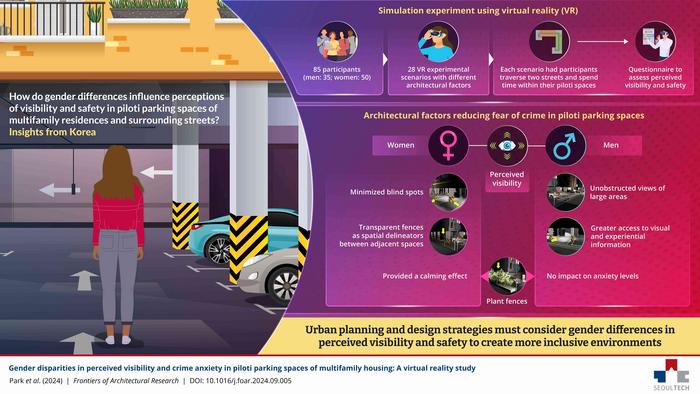
Multifamily residential buildings with multiple floors are common in South Korea. These buildings usually have pilotis—support structures like pillars that elevate the building, creating an open ground floor generally used for parking vehicles. These piloti parking spaces are often risky to navigate for pedestrians and residents due to limited visibility, unclear boundaries between adjacent areas, and poor management. For instance, these spaces have blind spots that criminals could exploit, which induces fear among people.
Though evidence-based architectural design strategies can improve urban safety, few studies have examined the relationship between the architectural designs of piloti parking spaces, perceived visibility, and crime anxiety. With the rise in gender-based crimes, it is also crucial to understand how gender influences these dynamics.
In this vein, a research team including Assistant Professor So Yeon Park from the School of Architecture at Seoul National University of Science and Technology, South Korea, Professor Gisung Han from the Korea Advanced Institute of Science and Technology, Assistant Professor Jee Heon Rhee, Gachon University, and Professor. Kyung Hong Lee from the Korea University investigated how different architectural configurations of piloti parking spaces and surrounding streets impacted visibility and fear of crime among men and women. Dr. Park highlights, “We also propose design strategies for improving the environment of piloti parking areas and reducing users’ fear of crime.” The study was made available online on November 15, 2024, in the journal Frontiers of Architectural Research.
Researchers used virtual reality (VR) to conduct simulation experiments with 85 participants. They created 28 scenarios with varying entrance, boundary, structure, and lighting configurations. Each participant navigated four scenarios and completed questionnaires integrated into the virtual environment to assess perceived visibility and safety.
“Consistent with previous studies, perceived visibility significantly reduced fear of crime for both genders. However, men and women prioritized different aspects of visibility,” says Dr. Park.
For men, any obstruction in their view of the surroundings negatively impacted their visibility. For women, architectural features like walls and side entrances, which create blind spots, negatively impacted their visibility. This is because women were more concerned with unexpected threats within their immediate vicinity than having a clear view of their surroundings.
Sign up for the Daily Dose Newsletter and get every morning’s best science news from around the web delivered straight to your inbox? It’s easy like Sunday morning.
Unlike men, women prioritized architectural features that offered both visibility and safety. They perceived transparent fences not as visual barriers but as spatial boundaries between nearby spaces and physical barriers that offered protection while allowing women to monitor their surroundings. Similarly, plant fences had a calming effect that reduced crime anxiety among women.
Personal histories also shaped the fear of crime. While men’s experiences of living in multifamily housing reduced their crime anxiety, women’s experiences of victimization increased their crime anxiety.
Thus, architects and urban planners must ensure gender-sensitive design to create safer, inclusive urban environments. Dr. Park emphasizes, “Design strategies like having unobstructed visibility can reduce crime anxiety among men, while having transparent or low-height tree fences and minimizing blind spots can mitigate women’s fear and increase surveillance.”
Hopefully, these insights will direct global efforts toward incorporating innovative approaches like VR in urban planning and creating safer cities for all genders.
IMAGE CREDIT: Dr. Kyung Hoon Lee from Korea University



Leave a Reply