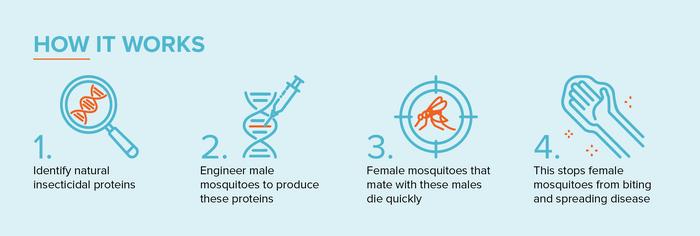
A revolutionary new biological pest control method that targets the lifespan of female insects could significantly reduce the threat of insect pests such as disease-carrying mosquitoes by offering faster and more effective results than current methods.
Described today in Nature Communications, the technique developed by researchers in Applied BioSciences and the ARC Centre of Excellence in Synthetic Biology at Macquarie University is a new approach called the Toxic Male Technique (TMT).
It works by genetically engineering male insects to produce insect-specific venom proteins in their semen. When these males mate with females, the proteins are transferred, significantly reducing female lifespan and their ability to spread disease.
Insect pests pose a growing threat to global health and agriculture, causing hundreds of thousands of deaths, millions of infections, and costing billions in healthcare and crop damage annually.
In mosquitoes like Aedes aegypti and Anopheles gambiae, only the females bite and transmit diseases such as malaria, dengue, Zika, chikungunya disease and yellow fever.
Pesticides face declining effectiveness due to resistance and have caused harm to non-target species and ecosystems. Genetic biocontrol has emerged as a promising alternative.
Sign up for the Daily Dose Newsletter and get every morning’s best science news from around the web delivered straight to your inbox? It’s easy like Sunday morning.
Current techniques like the Sterile Insect Technique (SIT) or insects carrying lethal genes (RIDL) work by releasing massive numbers of sterilised or genetically modified males to mate with the wild females.
While these mated females produce no offspring or only male offspring, they continue to blood feed and spread disease until they die naturally – meaning populations of biting females only decrease when the next generation emerges.
By immediately reducing the biting female population, TMT offers significant advantages over competing genetic biocontrol methods.
“As we’ve learned from COVID-19, reducing the spread of these diseases as quickly as possible is important to prevent epidemics,” says lead author Sam Beach.
“By targeting the female mosquitoes themselves rather than their offspring, TMT is the first biocontrol technology that could work as quickly as pesticides without also harming beneficial species.”
Laboratory tests using fruit flies (Drosophila melanogaster) demonstrated that females mated with TMT males had lifespans shortened by 37–64 per cent compared to those mated with unmodified males.
Computer models predict that applying TMT to Aedes aegypti, a highly aggressive mosquito species primarily responsible for transmitting Dengue and Zika, could reduce blood-feeding rates—a key factor in disease transmission—by 40 to 60 per cent compared to established methods.
Rigorous safety testing
Safety and environmental safety are central to the TMT approach. Venoms naturally contain a mixture of many proteins, and those used in TMT are very carefully selected.
Their targets are only present within invertebrates, so they aren’t toxic in any way to mammals, and they are not likely to cause harm when consumed by beneficial insects since their oral toxicity is very low.
The current study was performed in Associate Professor Maciej Maselko’s lab and provides the proof of concept for this breakthrough approach for suppressing the populations of pest species.
‘We still need to implement it in mosquitoes and conduct rigorous safety testing to ensure there are no risks to humans or other non-target species,” says Associate Professor Maselko.
“This innovative solution could transform how we manage pests, offering hope for healthier communities and a more sustainable future,” says Beach.
IMAGE CREDIT: ARC Centre of Excellence in Synthetic Biology.




Leave a Reply