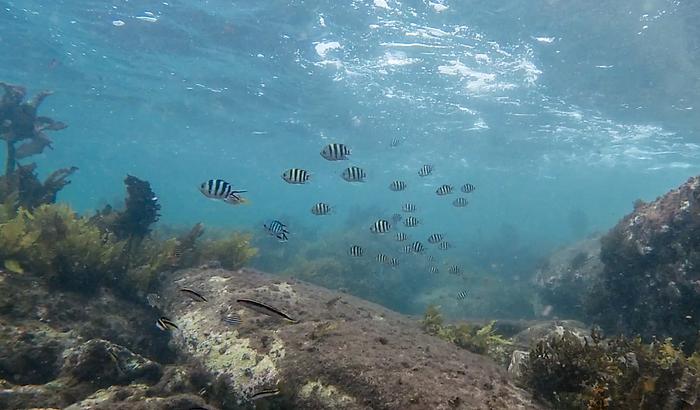
A University of Adelaide study of shallow-water fish communities on rocky reefs in south-eastern Australia has found climate change is helping tropical fish species invade temperate Australian waters.
“The fish are travelling into these Australian ecosystems as larvae caught in the Eastern Australian Current, which is strengthening due to the warming climate,” said the University of Adelaide’s Professor Ivan Nagelkerken, Chief Investigator of the study.

“These larvae would not normally survive in the cooler Australian ocean water, but the warming Eastern Australian Current keeps the baby fish warm and increases their likelihood of survival.”
The novel populations of tropical fish in temperate ecosystems are not having much of an impact now, but may do in the future.
Sign up for the Daily Dose Newsletter and get every morning’s best science news from around the web delivered straight to your inbox? It’s easy like Sunday morning.
“Because water temperatures in temperate Australia are still a bit cool, these tropical fish do not grow to their maximum size and therefore are not fully competing with temperate Australian fish – yet,” says Professor David Booth of the University of Technology Sydney, a co-Chief Investigator of the study.
“However, under increasing future ocean warming these tropical fish will eventually grow to their full size, and their diets will start to overlap more and more with those of temperate fish.
“It is the expectation that these tropical fish will be permanently established in temperate Australia, where they will become serious competitors with the native temperate fish that have historically lived there.”
While the University of Adelaide study, led by PhD student Minami Sasaki, focused on fish communities off New South Wales, Professor Nagelkerken says similar changes in water temperature are also being seen in south-western Australia and overseas.
He says the fish migration observed in this study is “an ongoing process that has strengthened in the last few decades due to ocean warming”.
The broader impacts on the ecosystems these fish invade are not yet clear.
““Tropical herbivores overgraze temperate kelp, but for the tropical invertebrate eaters, we are not sure yet what it means for the ecosystem itself,” says Professor Nagelkerken.
An earlier study led by University of Adelaide PhD candidates Chloe Hayes and Angus Mitchell, and also involving Okinawa Institute of Science and Technology Graduate University and University of Technology Sydney, showed tropical generalists might fare better than the specialist temperate fish they’re muscling in on.
“We’ve seen that ocean warming physiologically benefits tropical generalists but disadvantages temperate specialists, which may mean the generalists will be more successful in the initial stages of climate change,” says Hayes.
“Generalist tropical species that are less fussed about what they eat or what habitats they use as shelter appear to be the most successful tropical invaders.”
“This could make survival difficult for Australian fish that are native to these rapidly warming temperate environments,” Professor Nagelkerken says.
IMAGE CREDIT: University of Adelaide
If you enjoy the content we create and would like to support us, please consider becoming a patron on Patreon! By joining our community, you’ll gain access to exclusive perks such as early access to our latest content, behind-the-scenes updates, and the ability to submit questions and suggest topics for us to cover. Your support will enable us to continue creating high-quality content and reach a wider audience.
Join us on Patreon today and let’s work together to create more amazing content! https://www.patreon.com/ScientificInquirer



Leave a Reply