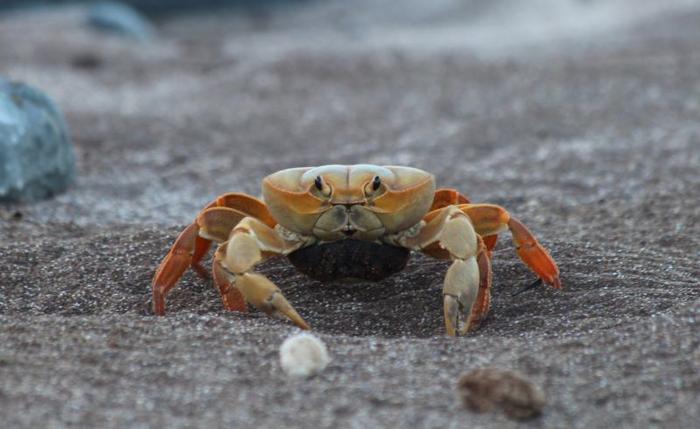
Mass migration takes place between December and April on Trindade Island, the easternmost point of Brazil located in the Atlantic about 1,200 km from the coastal city of Vitória, capital of Espírito Santo state. Hundreds of Johngarthia lagostoma land crabs descend steep rocky trails from the upland peaks to the shore, where they mate and release larvae into the ocean.
The larvae develop into juveniles, which undertake an even more challenging journey back up to the heights in search of safe places in which to make the burrows they call homes. Their favorite sites are hilltops like Morro do Príncipe or Pico do Desejado, 136 m and 612 m above sea level respectively. In adulthood, they follow in their ancestors’ footsteps down to the shore, where the reproductive cycle is repeated on beaches like Praia dos Andradas.

The above information may seem basic but it is essential to conservation of this endangered species. It was obtained by Brazilian researchers in a project supported by FAPESP, along with a large amount of vitally important data on the crab’s breeding and other habits. Their findings are reported in an article published in the journal Marine Ecology.
The group was led by scientists affiliated with São Paulo State University (UNESP) and included colleagues from the Federal University of the ABC (UFABC) and the Federal University of Santa Catarina (UFSC).
Sign up for the Daily Dose Newsletter and get every morning’s best science news from around the web delivered straight to your inbox? It’s easy like Sunday morning.
After a series of analyses, the researchers concluded that Morro do Príncipe, the hill on which the largest proportion of juveniles was found, and Praia dos Andradas, the beach with the most egg-bearing females and other adults, should be considered priority areas for conservation of the species. Praia das Tartarugas and Pico do Desejado were classed as residential areas for the animals.
“Although Trindade Island is part of a conservation unit and has so far been satisfactorily protected, special care is advisable to assure effective conservation. Juveniles remain in Morro do Príncipe until they reach adulthood, so this area is important to maintain the population in the long run. Praia dos Andradas is a vital breeding ground,” said Márcio Camargo Araújo João, first author of the article. The study was part of his master’s research, which was supported by a scholarship from FAPESP. He is affiliated with São Paulo State University’s Institute of Biosciences on the Coastal Experiment Campus (IB-CLP-UNESP) in São Vicente.
Habitats of this land crab
J. lagostoma occurs in Brazil on the islands of the Fernando de Noronha archipelago and Atol das Rocas, as well as Trindade. It is also endemic to Ascension Island, a British Overseas Territory in the South Atlantic.
The only human inhabitants of Trindade, which is the tip of a large volcanic seamount, belong to a Brazilian Navy base and science station. Some 40 people work two-month shifts on this 13-square-kilometer island.
Most crab species spend their lives in contact with water, but land crabs have adapted to life in the bush, and use the sea only while developing and to disperse larvae. For this reason, it is vital to conserve the vegetation in order to assure survival of the species.
“The island’s forest is smaller than Ascension’s, for example, but there are many more crabs on Trindade, where they’re well-established, feeding not only on the vegetation but also on turtle eggs and hatchlings. They’re the apex predators and have no competitors,” said Marcelo Antonio Amaro Pinheiro, last author of the article and a professor at IB-CLP-UNESP.
“Humans have a far greater impact on Fernando de Noronha, with 3,167 inhabitants and almost 150,000 tourists in 2022. Their impact ranges from urbanization to the presence of introduced species such as cats, dogs and rats.”
Pinheiro is responsible for monitoring endangered species of Brazilian crustaceans for the Chico Mendes Institute of Biodiversity Conservation (ICMBio), an arm of the Environment and Climate Change Ministry. J. lagostoma is classified as endangered in Brazil in the latest list.
The study can help include the species in the IUCN’s Red List of Threatened Species, a global inventory of the conservation status of animal and plant species.
Night on Trindade
The researchers investigated the presence of the species on the two beaches and two hills during the breeding period, which runs from December through to April. Their study covered February-April 2019 and December 2019-February 2020.
They randomly selected individuals at night, when these crabs are most active, measuring carapace width and chela (pincer) length. They determined the sex of each individual on the basis of carapace shape and number of pleopods, small legs on the underside of the thorax used in mating and to carry eggs (brooding). J. lagostoma cannot be captured because it is an endangered species, so the specimens used in the study were released after the measurements were taken on each night of the study.
The researchers observed that males were more frequent in the population. The same pattern has been found in other land crabs, although on Praia dos Andradas the proportions of males and females were similar among adults. According to the authors, mortality is higher among females owing to heat stress and energy expenditure during migrations between the hillside habitat and the shore (and vice-versa), including the journey with eggs, as well as the lack of vegetation and shelter on the beaches.
“We saw many dead females in breeding grounds near the shore. This confirmed information from researchers who studied the species on Ascension,” João said.
On Ascension, however, only 1% of the crabs observed were juveniles, which was considered a sign of an aging population and prospective local extinction. On Trindade, the proportion was 20% (up to 30% on Morro do Príncipe), indicating sufficient population vitality.
“This is the picture we have at the moment, but it’s important to continue monitoring the species in other parts of the island to try to confirm patterns that may have gone unnoticed. In addition, concomitant investigation of these parameters on other Brazilian islands where the species occurs could provide an integrated profile that would serve as a basis for a more effective nationwide conservation plan,” João said.
IMAGE CREDIT: Márcio Camargo Araújo João
If you enjoy the content we create and would like to support us, please consider becoming a patron on Patreon! By joining our community, you’ll gain access to exclusive perks such as early access to our latest content, behind-the-scenes updates, and the ability to submit questions and suggest topics for us to cover. Your support will enable us to continue creating high-quality content and reach a wider audience.
Join us on Patreon today and let’s work together to create more amazing content! https://www.patreon.com/ScientificInquirer


Leave a Reply