HAVE YOUR SAY.
Join us in The Bullpen, where the members of the Scientific Inquirer community get to shape the site’s editorial decision making. We’ll be discussing people and companies to profile on the site. On Wednesday, April 26 at 5:30pm EST, join us on Discord and let’s build the best Scientific Inquirer possible.
Development of neural networks or AI tools for data analysis is increasing exponentially. However, networks existing in natural ecosystems, such as webs of interspecies relationships, have information processing potential that has largely remained untapped.
Now, a study conducted at Kyoto University has demonstrated the computational power of ecosystems, providing a new direction for rapidly developing AI technologies. Simulations have confirmed that ecological networks, such as prey-predator interactions, can efficiently process information and be utilized as a computational resource.
“We have named this approach ecological reservoir computing,” says Kyoto University’s lead author Masayuki Ushio.

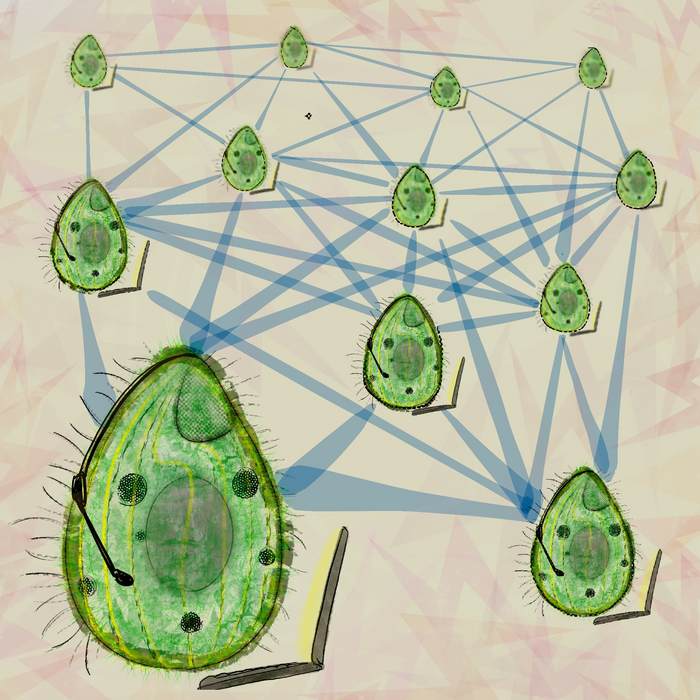
The researchers developed two types of ecological reservoir computing as a proof-of-concept that ecological networks have computational power.
One type is a computer-based approach called in silico ecological reservoir computing, which models hypothetical ecosystem dynamics and simulates the system response. The second is an empirical system called real-time ecological reservoir computing, which uses the real-time population dynamics of the unicellular organism Tetrahymena thermophila.
In the second approach, to confirm the computational power of a natural ecological system, Ushio’s team set up an experimental design using Tetrahymena thermophila. After entering values as the temperature of the culturing medium — or input data — the team obtained cell numbers as system output. The study confirmed the possibility that the Tetrahymena population could make near-future predictions of ecological time series.
“Our results also suggest that there might be a link between high biodiversity and high computational power, shedding light on new values of previously unknown biodiversity,” adds Ushio, currently a principal investigator at The Hong Kong University of Science and Technology.
“A direct relationship between a community’s diversity and computational capability may enhance its biodiversity quotient.”
Ecological communities process a large amount of information in real time in a natural ecosystem, where the potential of ecological interactions to serve as a novel computing method is significantly high.
“Our new computing method might lead to the invention of novel types of computers. Also, in developing a way to measure the information processing capacity of a natural ecosystem, we may find clues to how ecosystem dynamics are maintained,” concludes Ushio.
IMAGE CREDIT: KyotoU/Jake Tobiyama




Leave a Reply