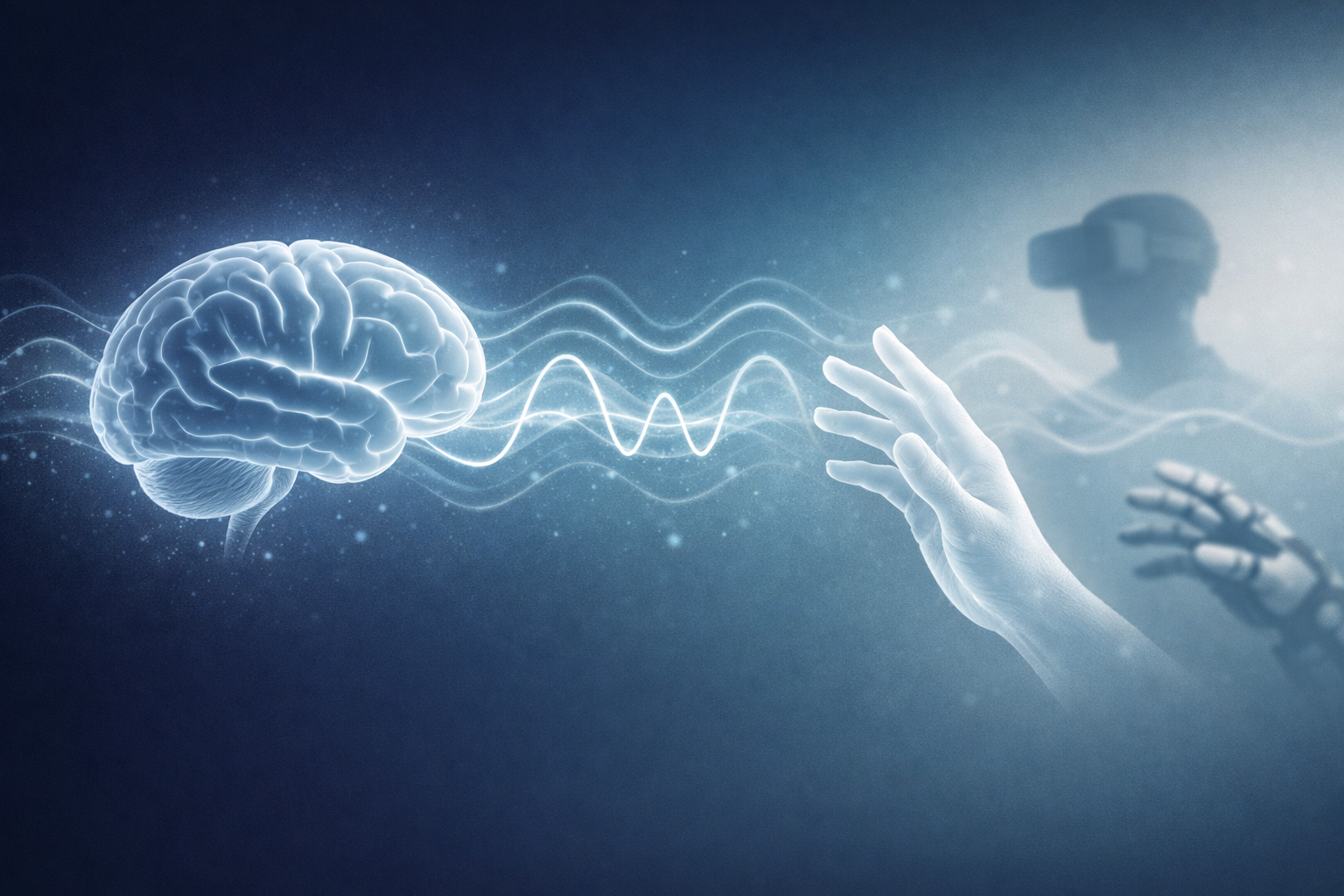
New research reveals that the rhythm of your brain waves determines how you perceive your own body—with implications for prosthetics, virtual reality, and understanding schizophrenia
What makes your hand feel like your hand? It seems like a simple question with an obvious answer, but scientists have long puzzled over how the brain creates this fundamental sense of body ownership—the feeling that your limbs belong to you rather than to someone or something else.
Now, researchers at Sweden’s Karolinska Institutet have discovered a surprising answer: the speed of electrical rhythms pulsing through your brain determines how precisely you distinguish your body from the external world. Their findings, published this week in Nature Communications, could transform everything from prosthetic limb design to virtual reality experiences.
“We have identified a fundamental brain process that shapes our continuous experience of being embodied,” explains lead author Mariano D’Angelo, a researcher at Karolinska’s Department of Neuroscience.
The Brain’s Metronome
At any given moment, your brain hums with rhythmic electrical activity. Among the most prominent of these oscillations are alpha waves, cycling roughly 8 to 13 times per second. Scientists have long known these waves play a role in attention and sensory processing, but their connection to something as intimate as body ownership remained unclear.
To investigate, D’Angelo and his colleagues turned to a classic psychological experiment called the rubber hand illusion. First described in 1998, this illusion works like a magic trick on the brain: when someone watches a rubber hand being stroked with a brush while their own hidden hand is stroked simultaneously, something remarkable happens. Within minutes, most people begin to feel as though the fake hand is actually part of their body.
The timing proves crucial. When the touches on the rubber hand and real hand are perfectly synchronized, the illusion takes hold powerfully. But introduce even small delays—a fraction of a second between what you see and what you feel—and the illusion weakens or disappears entirely. The brain, it seems, uses timing as a critical cue for deciding whether sensory signals belong together.
This temporal window during which the brain “binds” separate sensory signals into a unified experience is called the temporal binding window. The Swedish team suspected that alpha waves might act as the brain’s internal clock, determining how wide or narrow this window is from person to person.

Faster Brains, Sharper Boundaries
The researchers recruited 106 participants across three experiments, combining behavioral testing with brain recordings and stimulation. They measured each participant’s individual alpha frequency—the specific speed at which their brain’s alpha waves oscillate—using electroencephalography (EEG) electrodes placed over the parietal cortex, a brain region crucial for processing bodily sensations.
The results were striking. Participants with faster alpha frequencies showed narrower temporal binding windows. They were more sensitive to tiny timing differences between what they saw and what they felt, requiring near-perfect synchronization before the rubber hand illusion fooled them. Those with slower alpha frequencies showed the opposite pattern: they tolerated larger timing mismatches, accepting the rubber hand as their own even when the visual and tactile signals were noticeably out of sync.
Think of it like the frame rate on a video camera. A camera shooting at 60 frames per second captures motion with more precision than one shooting at 30 frames per second. Similarly, a brain with faster alpha waves samples sensory information more frequently, creating finer temporal resolution. Each “perceptual frame” is shorter, making it harder for the brain to mistakenly lump together signals that didn’t actually occur at the same time.
The correlation between alpha frequency and body ownership was remarkably consistent. It held whether researchers measured alpha waves during rest or while participants performed the tasks. And it appeared in both hemispheres of the parietal cortex.
From Correlation to Causation
But correlation doesn’t prove causation. Maybe people with faster alpha waves simply have different brains in ways that affect both their oscillation speed and their perceptual abilities, without one causing the other.
To nail down the causal relationship, the team used a technique called transcranial alternating current stimulation, or tACS. By applying gentle electrical currents to the scalp that oscillate at specific frequencies, researchers can temporarily nudge the brain’s natural rhythms faster or slower.
Participants completed the rubber hand illusion task across three sessions on different days, each time receiving either low-frequency stimulation (8 Hz), high-frequency stimulation (13 Hz), or a sham condition serving as a control. Neither the participants nor the experimenters running the sessions knew which condition was being administered until after the data were analyzed.
The manipulation worked exactly as predicted. When alpha waves were pushed toward the slower end of the spectrum, participants’ temporal binding windows widened—they became more susceptible to the illusion even with substantial timing mismatches. When alpha waves were accelerated, the opposite occurred: binding windows narrowed and participants became more discriminating about synchronization.
“Our findings help explain how the brain solves the challenge of integrating signals from the body to create a coherent sense of self,” says Henrik Ehrsson, professor at the Department of Neuroscience and the study’s senior author.

The Bayesian Brain
To understand precisely how alpha frequency shapes perception, the researchers developed a computational model based on Bayesian inference—the mathematical framework describing how the brain combines prior expectations with incoming sensory evidence.
When you encounter sensory signals from multiple sources, your brain must solve an inference problem: did these signals come from the same cause or different causes? If you see and feel a touch at nearly the same moment, they probably share a common source (your body). If they’re widely separated in time, they likely reflect different events.
The model revealed that alpha frequency specifically affects sensory uncertainty—how much “noise” or imprecision the brain assigns to the timing information it receives. Faster alpha frequencies corresponded to lower uncertainty, meaning the brain treats its timing estimates as more reliable. With more reliable timing information, the brain becomes more decisive about segregating signals that don’t match up perfectly.
This finding connects alpha rhythms to one of neuroscience’s most influential theories: that the brain operates as a prediction machine, constantly weighing sensory evidence against prior beliefs. Alpha waves, the researchers suggest, act as a fundamental parameter in this computational process, setting the precision with which temporal information enters the inference.
Beyond the Laboratory
The implications extend far beyond understanding a laboratory illusion.
Consider prosthetic limbs. Current artificial arms and hands can perform impressive feats of movement, but users consistently report that something feels “off”—the prosthetic never quite feels like part of their body. One reason may be timing delays between sensory feedback from the prosthesis and the user’s own movements. Research has shown that better brain-prosthetics integration requires reducing the timing gap between motor commands and sensory information. Understanding how alpha rhythms govern the acceptable window for integration could help engineers design devices that feel more natural.
Virtual reality faces similar challenges. For a VR experience to feel truly immersive, users need to feel embodied in their avatar—they need to feel that the virtual body is their own. Studies have consistently shown that the sense of body ownership in VR depends critically on synchronized visual and tactile feedback. The new findings suggest that VR developers might need to account for individual differences in users’ alpha frequencies when optimizing synchronization parameters.
“This can contribute to the development of better prosthetic limbs and more realistic virtual reality experiences,” Ehrsson notes.

A Window into Mental Illness
Perhaps most intriguing are the implications for psychiatry. Disruptions in the sense of self are hallmarks of schizophrenia, a condition affecting roughly one percent of the population worldwide. Patients often report experiences suggesting disordered body ownership—feeling disconnected from their own actions, uncertain about the boundaries between self and world, or subject to beliefs that external forces control their movements.
Previous research has documented that people with schizophrenia tend to have slower alpha frequencies in posterior brain regions. The new findings suggest a potential mechanism: slower oscillations might create greater uncertainty in temporal perception, making it harder to distinguish between signals originating from one’s own body versus external sources.
“The findings may provide new insights into psychiatric conditions such as schizophrenia, where the sense of self is disturbed,” D’Angelo explains.
If slower alpha frequency translates to more uncertain timing perception, individuals with schizophrenia might be more prone to “overreliance” on prior beliefs rather than sensory evidence—a pattern some researchers have proposed as central to the disorder’s unusual perceptual experiences. This doesn’t mean alpha frequency causes schizophrenia, but it might represent one piece of the neural machinery that goes awry.
The Rhythm of Being
The study stands out for its methodological rigor. Where previous research had produced inconsistent findings about alpha oscillations and temporal perception, the Swedish team combined multiple convergent approaches: correlational evidence from EEG, causal evidence from brain stimulation, and computational modeling to explain the mechanism.
The work also highlights something profound about human experience. Our sense of inhabiting a body—perhaps the most fundamental aspect of conscious existence—doesn’t arise from some unified “self” module in the brain. Instead, it emerges from basic processes of sensory integration, governed by rhythms we never consciously perceive.
Every time you reach for a coffee cup and it feels like your hand doing the reaching, your parietal cortex is running through billions of oscillation cycles, sampling sensory signals, computing probabilities, and arriving at the conclusion that yes, this body belongs to you. The whole process takes fractions of a second and happens entirely outside awareness.
For most of us, most of the time, this machinery operates flawlessly. But understanding how it works opens possibilities for helping those for whom embodiment doesn’t come so easily—whether due to amputation, neurological injury, or psychiatric illness. The brain’s internal clock, it turns out, keeps time for far more than we ever realized.
Sources
- D’Angelo, M., Lanfranco, R.C., Chancel, M., & Ehrsson, H.H. (2026). Parietal alpha frequency shapes own-body perception by modulating the temporal integration of bodily signals. Nature Communications, 17:53. doi: 10.1038/s41467-025-67657-w
- Karolinska Institutet Press Release (January 12, 2026). “How brain waves shape our sense of self.” EurekAlert.
- Ramsay, I.S., Lynn, P.A., Schermitzler, B., & Sponheim, S.R. (2021). Individual alpha peak frequency is slower in schizophrenia and related to deficits in visual perception and cognition. Scientific Reports, 11, 17852.
- Cecere, R., Rees, G., & Romei, V. (2015). Individual differences in alpha frequency drive crossmodal illusory perception. Current Biology, 25, 231-235.
- Di Gregorio, F., et al. (2022). Tuning alpha rhythms to shape conscious visual perception. Current Biology, 32, 988-998.
- Samaha, J. & Postle, B.R. (2015). The speed of alpha-band oscillations predicts the temporal resolution of visual perception. Current Biology, 25, 2985-2990.
- Botvinick, M. & Cohen, J. (1998). Rubber hands ‘feel’ touch that eyes see. Nature, 391, 756.


Leave a Reply