A research team led by Prof. ZHU Min—member of the Chinese Academy of Sciences (CAS) and affiliated with the CAS Institute of Vertebrate Paleontology and Paleoanthropology (IVPP)—has identified a new species of fossil lungfish from Early Devonian deposits in Zhaotong, Yunnan Province. The findings, published recently in the journal Current Biology, help fill a long-standing gap in scientists’ understanding of lungfishes’ early evolutionary history.
Lungfishes are the closest living relatives of tetrapods. First appearing during the Devonian Period, they underwent rapid diversification; today, however, only three genera of lungfishes remain.
The newly discovered species, Paleolophus yunnanensis, dates to about 410 million years ago. It provides a clear morphological link between the earliest confirmed lungfish species, Diabolepis speratus, which was found in Early Devonian strata in South China, and later species. Such a link had eluded researchers for decades.

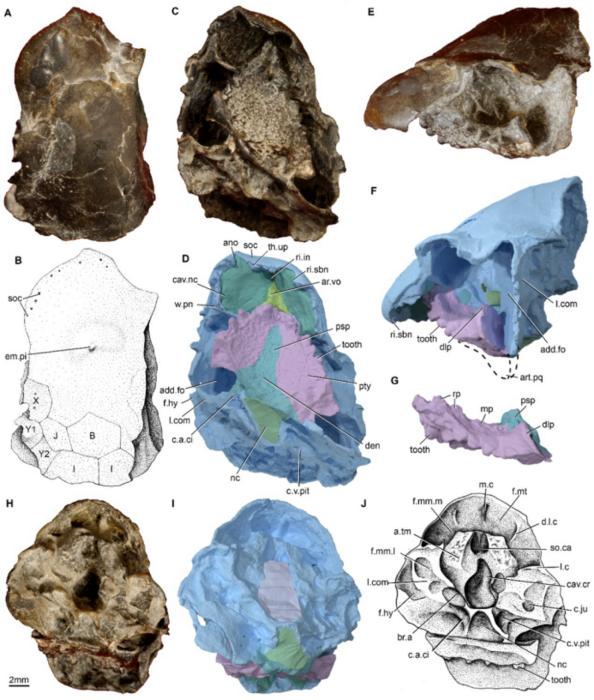
Paleolophus represents the world’s first known three-dimensionally preserved lungfish skull from the Pragian Stage. Measuring just 25 millimeters in length, the skull is exceptionally informative. High-resolution CT scans reveal that Paleolophus combines primitive traits shared with Diabolepis, including teeth on the upper lip and a prominent pineal region, while also displaying characteristics typical of early true lungfishes.
In addition, Paleolophus possesses unique adaptive traits, such as an unusually enlarged nasal cavity and strongly developed jaw muscles. These features suggest the species may have had a diet that included hard-shelled prey. Of particular significance is the partially fused palatoquadrate–neurocranial region, which captures a transitional stage between the primitive “dual articulation” of early sarcopterygians and the autostylic skull typical of true lungfishes.
Using CT data and phylogenetic analyses, the research team positioned Paleolophus at the base of “Eudipnoi” —a newly refined taxonomic group that includes all lungfishes except the earlier Diabolepis. By making use of precise geological dating, the study indicates that the evolutionary transition from Diabolepis to true lungfishes occurred over a mere four million years (between 416 and 412 million years ago), highlighting a period of rapid early diversification in lungfish lineages.
Furthermore, morphological similarities between Paleolophus and Early Devonian lungfishes found in North America offer new biogeographical clues. These similarities suggest that the South China Plate and North American Plate were either connected or geographically proximate during the Early Devonian.
IMAGE CREDIT: Prof. ZHU Min’s team.


Leave a Reply