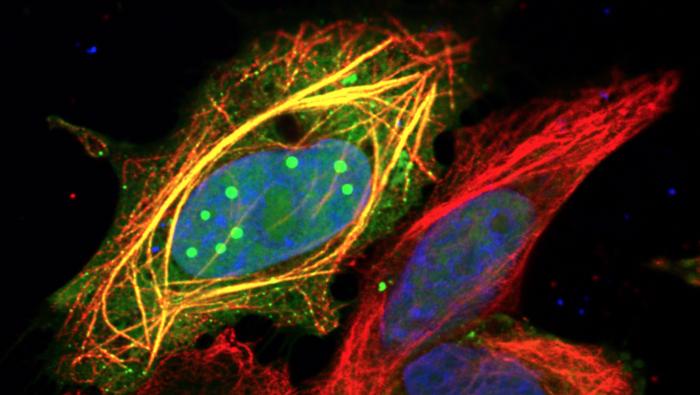
New antivirals and vaccines could follow the discovery by Australian researchers of strategies used by viruses to control our cells.
Led by Monash University and the University of Melbourne, and published in Nature Communications, the study reveals how rabies virus manipulates so many cellular processes despite being armed with only a few proteins.
Researchers believe other dangerous viruses like Nipah and Ebola may also work the same way, possibly enabling the development of antivirals or vaccines to block these actions.
Co-senior author Associate Professor Greg Moseley, head of the Monash Biomedicine Discovery Institute’s (BDI) Viral Pathogenesis Laboratory, said the ability of viruses to “do so much with so little” was perhaps their most remarkable skill.
“Viruses such as rabies can be incredibly lethal because they take control of many aspects of life inside the cells they infect,” Associate Professor Moseley said. “They hijack the machinery that makes proteins, disrupt the ‘postal service’ that sends messages between different parts of the cell, and disable the defences that normally protect us from infection.
“A major question for scientists has been: how do viruses achieve this with so few genes? Rabies virus, for example, has the genetic material to make only five proteins, compared with about 20,000 in a human cell.”

Co-first author and Moseley Lab research fellow Dr Stephen Rawlinson, of the BDI’s Moseley Lab, said understanding how these few viral proteins performed so many tasks could unlock new ways to stop infection.
“Our study provides an answer,” he said. “We discovered that one of rabies virus’s key proteins, called P protein, gains a remarkable range of functions through its ability to change shape and to bind to RNA.
“RNA is the same molecule used in new-generation RNA vaccines, but it plays essential roles inside our cells, carrying genetic messages, coordinating immune responses, and helping make the building blocks of life.”
Co-senior author Professor Paul Gooley, head of the University of Melbourne’s Gooley Laboratory, said by targeting RNA systems, the viral P protein could switch between different physical ‘phases’ inside the cell.
“This allows it to infiltrate many of the cell’s liquid-like compartments, take control of vital processes, and turn the cell into a highly efficient virus factory,” Professor Gooley said.
“Although this study focused on rabies, the same strategy is likely used by other dangerous viruses such as Nipah and Ebola. Understanding this new mechanism opens exciting possibilities for developing antivirals or vaccines that block this remarkable adaptability.”
Dr Rawlinson said the study should change how scientists think about multifunctional viral proteins. “Until now, these proteins were often viewed like trains made up of several carriages, with each carriage (or module) responsible for a specific task,” he said.
“According to this view, shorter versions of a protein should simply lose functions as carriages are removed. However, this simple model could not explain why some shorter viral proteins actually gain new abilities. We found that multifunctionality can also arise from the way the ‘carriages’ interact and fold together to create different overall shapes, as well as forming new abilities such as binding to RNA.”
Associate Professor Moseley said this RNA binding allowed the protein to move between different physical ‘phases’ within the cell.
“In doing so, it can access and manipulate many of the cell’s own liquid-like compartments that control key processes, such as immune defence and protein production,” he said. “By revealing this new mechanism, our study provides a fresh way of thinking about how viruses use their limited genetic material to create proteins that are flexible, adaptable, and able to take control of complex cellular systems.”
IMAGE RESULTS: Stephen Rawlinson, Monash University.




Leave a Reply